An ace is probably the most flexible card you can receive in blackjack. Unlike every other rank, it can count as either 1 or 11, with the value changing to keep your hand alive where possible. That flexibility is what creates soft hands and is one reason aces feature so heavily in blackjack strategy. If you want to see the card in action, BetVictor’s live blackjack games include a range of tables with their own specific rules.
It sounds simple enough, but the ace can cause a bit of confusion for new players. Is A-5 worth 6 or 16? What happens if another card would take you over 21? And when should you actually hit or stand with an ace in your hand?

Quick Answer: What Is an Ace Worth in Blackjack?
An ace is worth either 1 or 11 in blackjack.
The game uses whichever value gives the hand the strongest total without taking it over 21.
For example:
- Ace + 7 = 18, with the ace counting as 11
- Ace + 7 + 9 = 17, because the ace changes to 1
- Ace + King = 21, which is a natural blackjack when those are your first two cards
You don’t normally need to choose the value manually. The ace adjusts between 1 and 11 depending on the cards in your hand.
Why Can an Ace Be Worth 1 or 11?
The two possible values stop an ace from becoming a liability as soon as another high card arrives.
Take A-5. At first, the hand is soft 16, with the ace valued at 11. Draw a 10 and the hand does not bust at 26. Instead, the ace drops to 1 and the new total becomes 16.
That ability to change value is what separates an ace from every other card in blackjack.
It also explains why the right decision is not always obvious from the total alone. A soft 16 and a hard 16 might both display the number 16, but they are very different hands because the soft version cannot bust from taking one additional card.
For a wider look at how those decisions fit together, our blackjack basic strategy guide covers hard hands, soft hands and pairs.
What Is a Soft Hand in Blackjack?
A soft hand is any blackjack hand where an ace is currently being counted as 11 without taking the total above 21.
Some common examples are:
- A-2 = soft 13
- A-5 = soft 16
- A-7 = soft 18
- A-8 = soft 19
They are called soft because there is room for the value of the ace to fall from 11 to 1 if another card would otherwise cause the hand to bust.
A hard hand is different. Either it contains no ace at all, or any ace in the hand must already count as 1.
That small distinction has a big effect on how the hand is played.
Example 1: Player Ace-5 vs Dealer 5
Suppose your opening cards are:
Player: A-5
Dealer: 5
That gives you soft 16.
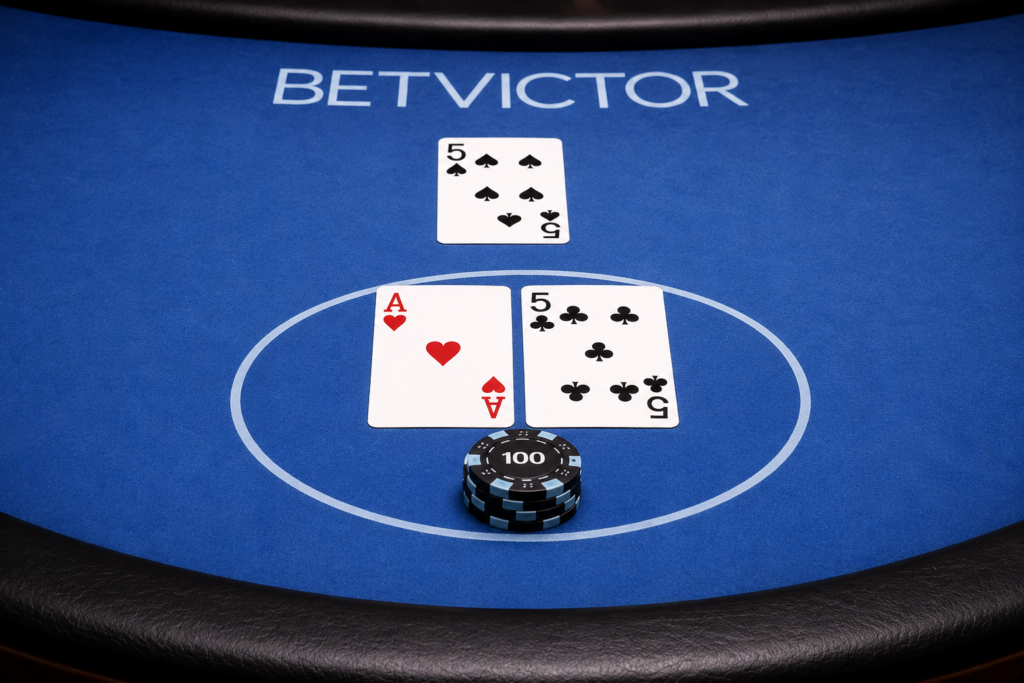
If doubling is not available, the correct basic-strategy play is to hit. A soft 16 has plenty of room to improve because taking one card cannot immediately bust the hand.
If the next card is a 10, for example, the ace simply changes from 11 to 1 and your total remains 16. A 2 takes you to soft 18, while a 4 gives you 20.
Under European blackjack rules where doubling is allowed on this hand, basic strategy can instead recommend doubling A-5 against a dealer 5. BetVictor’s current strategy chart lists A-4 and A-5 against dealer 4-6 as double if permitted, otherwise hit.
That is why checking the individual table rules matters rather than treating every blackjack game as identical.
Example 2: Player Ace-7 vs Dealer 7
Now imagine:
Player: A-7
Dealer: 7
Your cards make soft 18.
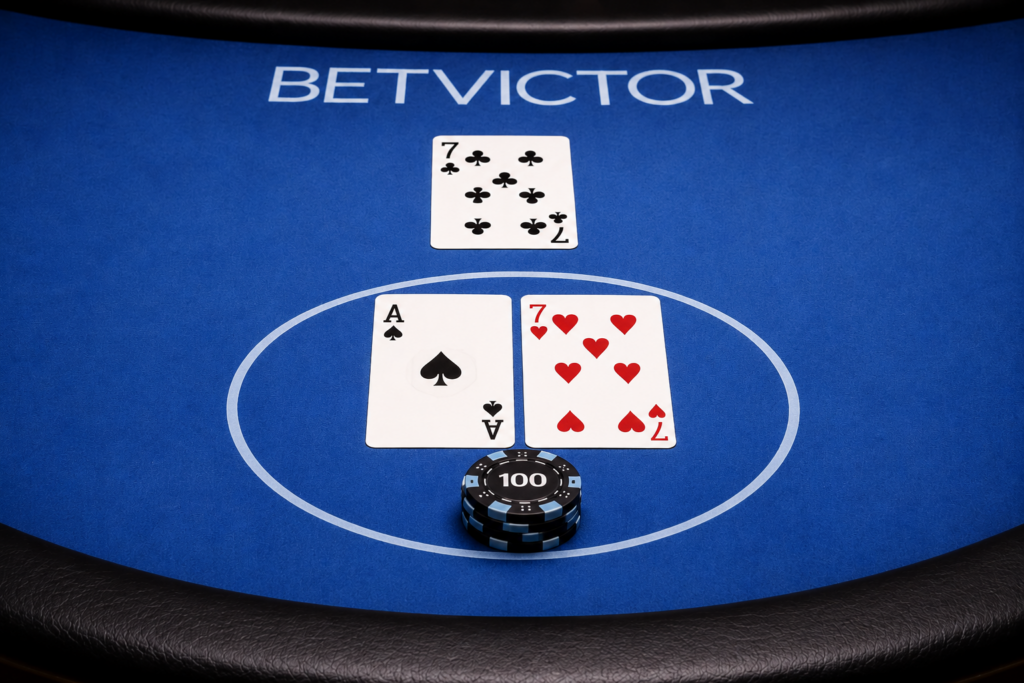
Here, the basic-strategy decision is stand.
Eighteen is already a reasonable total, and against a dealer 7 there is little need to chase a stronger hand. Taking another card may leave the ace counting as 1 and can turn a perfectly playable 18 into something less useful.
BetVictor’s European strategy guidance recommends standing with A-7 when the dealer shows 2, 7 or 8. Against weaker dealer cards such as 3 through 6, doubling may become an option instead.
For more examples of when leaving the hand alone is the preferred move, see our guide on when to stand in blackjack.
Can You Bust With an Ace in Blackjack?
Yes, but the ace itself gives you more protection than an ordinary card.
If your ace can switch from 11 to 1 and keep the hand at 21 or below, that happens first.
For example:
A-6-9 = 16, not 26.
The ace began as 11, but once the 9 arrived it had to become 1.
You only bust once even counting the ace as 1 still leaves the total above 21. If you had A-8-7-6, for instance, the lowest possible total would be 22 and the hand would be bust.
Is an Ace and a 10 Blackjack?
Yes, provided they are your first two cards.
An ace paired with any card worth 10 produces a natural blackjack:
- Ace + 10
- Ace + Jack
- Ace + Queen
- Ace + King
All four combinations total 21.
A hand that reaches 21 with three or more cards is still 21, but it is not normally treated as a natural blackjack. Payout rules also vary, so always check the table before playing.
What Happens if You Get Two Aces?
Two aces can’t both count as 11 because that would total 22. One therefore counts as 11 and the other as 1, giving you soft 12.
In many blackjack variants, a pair of aces is a strong candidate for splitting. That creates two separate hands, each beginning with an ace.
Pair decisions are a slightly different part of basic strategy because the dealer’s upcard and the table rules can change the correct move. If you’re working through those situations too, our new guide on whether you should split 8s in blackjack shows how much the ruleset can matter when deciding whether to split a pair.
Does the Dealer Use an Ace Differently?
No. An ace can still count as either 1 or 11 in the dealer’s hand.
The important difference is that the dealer does not choose freely whether to hit or stand. Their actions are set by the table rules.
One common rule concerns soft 17, such as A-6. Some tables require the dealer to stand on soft 17, while others require another card. That difference can affect basic strategy and the overall house edge.
This is another reason to check whether a blackjack table uses S17 or H17 rules before relying on a particular strategy chart.
Is an Ace Always a Good Card in Blackjack?
It is certainly useful, but having an ace does not automatically mean you have a strong hand.
A-2 is only soft 13. A-5 is soft 16. Both still need work.
The advantage is flexibility. You can take another card without immediately busting, and the ace may continue counting as 11 if the draw is small enough.
Once you get towards soft 18, 19 or 20, though, the hand becomes much more competitive and standing is often the better option.
What Is the Best Way to Play an Ace in Blackjack?
There isn’t one rule for every ace hand.
The dealer’s upcard matters, as does your second card and whether doubling is permitted. A-5 might need another card, while A-7 can be a stand, hit or double depending on what the dealer shows.
That’s exactly why soft hands have their own section on a blackjack basic strategy chart.
If doubling is available, it’s also worth understanding when the extra stake makes mathematical sense. Our guide to doubling down in blackjack covers the most common hard and soft totals.