Understanding when to split pairs in blackjack can help you make more informed decisions at the table. In most cases, players look to split Aces and 8s, while keeping pairs like 5s and 10-value cards together, always considering the dealer’s upcard. This becomes even more relevant in European blackjack, where the dealer takes a second card only after all players have acted. In this guide, we break down when to split in blackjack using simple, practical advice to support smarter play. Please remember, blackjack is a game of chance and no approach can guarantee results.
Here’s the quick answer for when to split (European rules):
- Always split: A-A and 8-8 against any dealer upcard
- Never split: 10-10 or 5-5 against any upcard
- Usually split: 9-9 vs dealer 2-6, 8, 9 (stand vs 7, 10, A); 7-7 vs dealer 2-7; 6-6 vs dealer 2-6 when double after split is allowed
- Conditional splits: Split 2s 3s and 7s vs dealer 2-7 when double after split (DAS) is permitted
| Your Pair | Dealer 2 | 3 | 4 | 5 | 6 | 7 | 8 | 9 | 10 | A |
|---|---|---|---|---|---|---|---|---|---|---|
| A,A | Split | Split | Split | Split | Split | Split | Split | Split | Split | Split |
| 10,10 | Stand | Stand | Stand | Stand | Stand | Stand | Stand | Stand | Stand | Stand |
| 9,9 | Split | Split | Split | Split | Split | Stand | Split | Split | Stand | Stand |
| 8,8 | Split | Split | Split | Split | Split | Split | Split | Split | Split | Split |
| 7,7 | Split | Split | Split | Split | Split | Split | Stand | Stand | Stand | Stand |
| 6,6 | Split | Split | Split | Split | Split | Stand | Stand | Stand | Stand | Stand |
| 5,5 | Double | Double | Double | Double | Double | Double | Double | Double | Hit | Hit |
| 4,4 | Hit | Hit | Hit | Split | Split | Hit | Hit | Hit | Hit | Hit |
| 3,3 | Split | Split | Split | Split | Split | Split | Hit | Hit | Hit | Hit |
| 2,2 | Split | Split | Split | Split | Split | Split | Hit | Hit | Hit | Hit |
This guide breaks down three concrete examples that illustrate why splitting is a game changer in blackjack: player 8-8 vs dealer 7, player A-A vs dealer 5, and player 3-3 vs dealer 4. All strategy assumes typical European blackjack rules in a live casino setting, including live blackjack, with no dealer hole card, the dealer standing on soft 17 and double after split allowed.

What Does “Split” Mean in Blackjack?
Simply put, splitting turns one starting hand with two cards of the same value into two separate hands by placing a second bet equal to your original wager.
Here’s how splitting works a bit differently at a European table:
- You signal the split by placing an equal bet next to your original bet
- The dealer separates your pair and deals one new card for each ace or other card
- You then play each hand independently – hitting, standing, or doubling as allowed
- What counts as a pair: two cards of the same rank (two eights, two 6s, two kings)
After splitting, you can usually hit, stand, and often double on each new hand according to table rules. The exception: when you split aces, you typically receive only one card for each ace and cannot hit further.
European Blackjack Split Rules That Affect Your Decisions
European blackjack splitting rules differ from American games in ways that directly impact your decisions:
- No-hole-card rule: The dealer draws their second card only after all players have acted. If you split or double and the dealer later makes blackjack, you lose all bets—including your second bet on split hands.
- Split Aces restrictions: You receive one card per Ace and cannot hit further. A 21 after splitting aces it counts as 21, not blackjack, so it pays 1:1 rather than 3:2.
- Re splitting limits: Many European tables allow re splitting up to 3 or 4 hands, but most prohibit re splitting Aces.
- Double after split (DAS): Usually allowed in European games. All advice in this guide assumes DAS is permitted – without it, some marginal splits like small pairs become less attractive.
Always check specific table rules before applying any blackjack split chart.
Core Strategy: When to Split in European Blackjack
This isn’t a gut-feeling guide. Basic strategy for splitting pairs like 8s, Aces, and small pairs is built on mathematical analysis of millions of hands.
Always split:
- A-A vs any dealer upcard – a pair of aces splitting into two hands starting at 11 is always superior to soft 12
- Split eights vs most dealer upcards, including 10 or A in no-surrender games
Never split:
- Split tens or face cards – 20 is already a premium hand
- 5-5 against any upcard – treat as hard 10 and usually double vs dealer 4–9
Usually split:
- Split 9s when dealer shows 2-6, 8, or 9 (stand vs 7, 10, A)
- Split 7s when dealer shows 2-7
- Split 6s when dealer shows 2-6 with DAS
Conditional splits:
- 2-2 and 3-3 vs dealer 2-7 when double after split is allowed
- Split 4s unless dealer shows 5 or 6 with DAS – otherwise just hit
The dealer’s upcard drives most decisions. You split more aggressively when the dealer has a weak hand showing (4, 5, 6) because they’re more likely to bust.
Key Examples: Why Splitting Is Strong in These European Blackjack Spots
This section breaks down three specific situations that demonstrate why knowing when to split can double your chances of winning or help you avoid costly mistakes:
- Player 8-8 vs dealer 7
- Player A-A vs dealer 5
- Player 3-3 vs dealer 4
Each example examines what happens if you don’t split versus what happens when you do, and why the math favors splitting under European rules.
Example 1: Player 8-8 vs Dealer 7 – Why You Split
You’re looking at hard 16 against a dealer showing 7 – one of the most uncomfortable positions in blackjack if you don’t split.
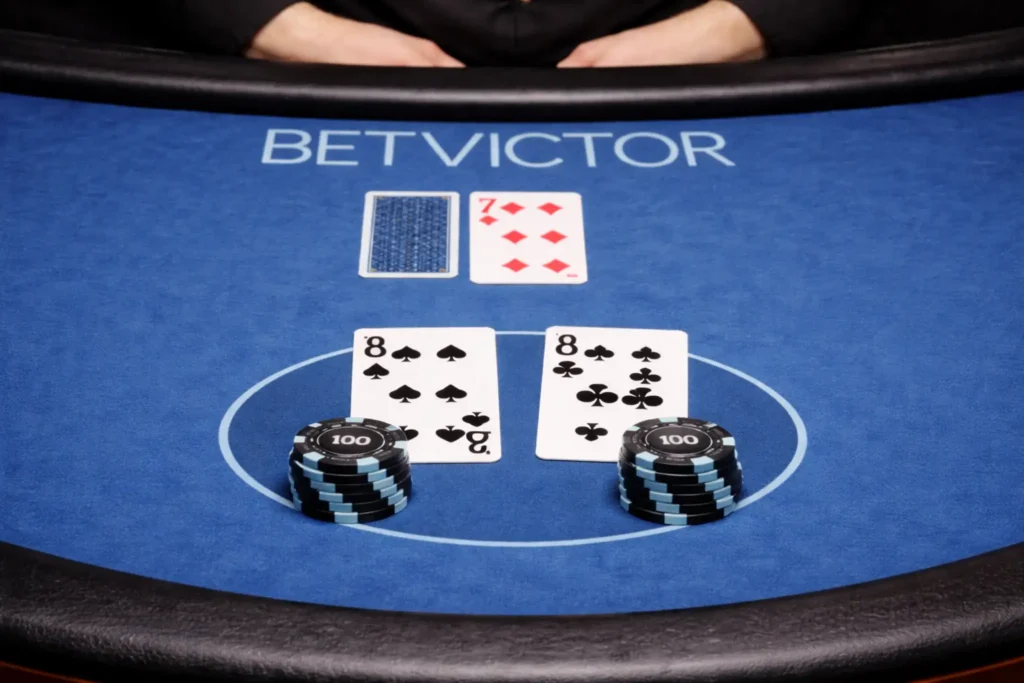
If you don’t split:
- Standing on 16 leaves you with a weak total that loses frequently to dealer 17-21
- Hitting is equally poor – you bust immediately with any 6 or higher (roughly 46% of cards)
- Mathematically, hard 16 vs 7 has negative expected value whether you hit or stand
If you split 8-8:
- You place a second bet and create two hands and splitting 8s transforms one disaster into two flexible starting points
- From each 8, drawing a 2 or 3 gives you 10 or 11 – strong double-down totals if rules allow
- Each hand can reach 17-21 without the immediate bust risk of hard 16
The advantage:
- One weak 16 vs 7 is a losing spot; two independent 8-starting hands each have around neutral to slightly positive expectation
- Even though you’re risking an extra bet, your expected loss per unit decreases enough to justify the split
- Basic strategy charts universally mark 8-8 vs 7 as “split” – this is standard play, not advanced tactics
Example 2: Player A-A vs Dealer 5 – Always Split Aces
Soft 12 against a dealer 5. The dealer has a weak hand, but you’re not capitalizing unless you split.
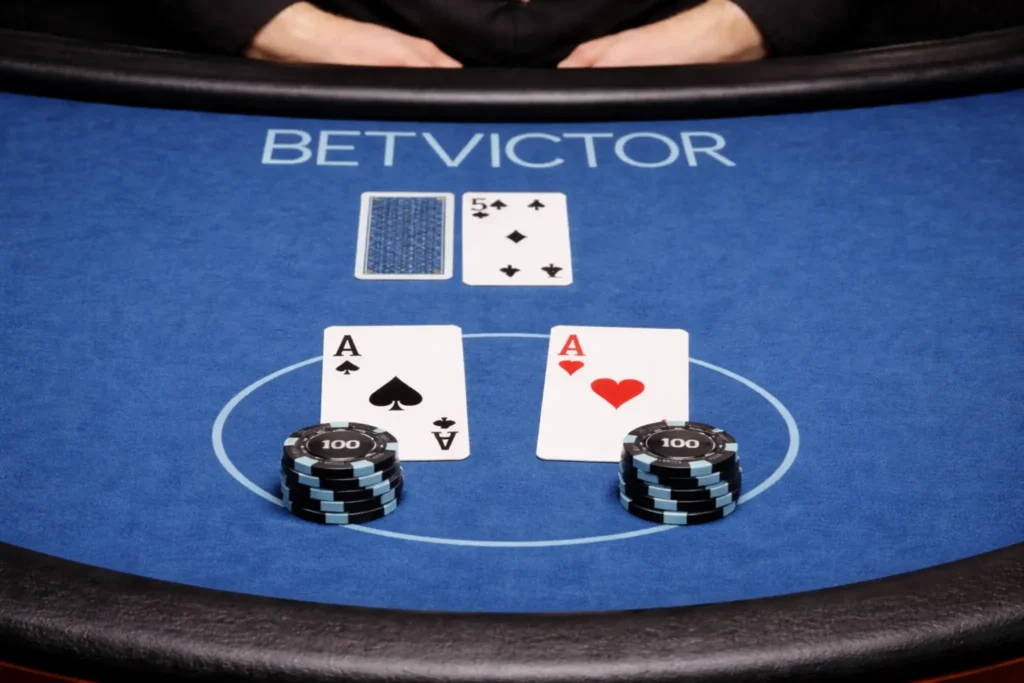
If you don’t split A-A:
- Treating A-A as soft 12 forces awkward decisions – hitting produces soft 13-17 or converts to hard totals
- Standing on 12 is wrong; 12 loses heavily against a dealer 5 that frequently hits to 17-21
- You’re wasting the power of two Aces
If you split A-A vs 5:
- You create two hands, each starting with an Ace valued as 11 – extremely powerful
- Against dealer 5, the dealer must hit and busts roughly 38% of the time
- Any 10-value card gives you 21; cards like 7, 8, or 9 produce totals of 18-0 that compete strongly vs a vulnerable dealer
European-specific considerations:
- Split Aces receive only one card each, and 21 pays 1:1, not 3:2
- Despite these restrictions and the no-hole-card risk, splitting A-A vs 5 remains significantly higher EV than any alternative
The advantage:
- Two starting Aces vs dealer 5 almost always outperform a single clumsy soft 12
- This is why every serious strategy says always split aces, especially against weak dealer upcards like 5 or 6
Example 3: Player 3-3 vs Dealer 4 – Small Pair, Big Edge with Split
You’re holding 3-3 (hard 6) against a dealer 4 – a classic situation where splitting outperforms hitting when double after split is allowed.
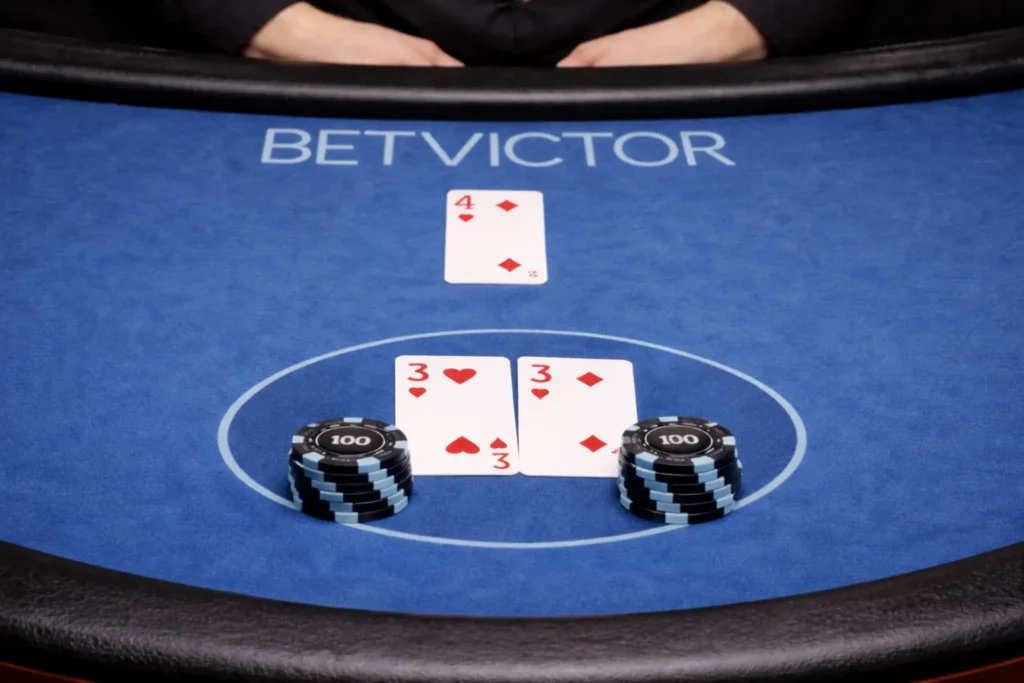
If you play 3-3 as a single hand:
- Hard 6 vs 4 isn’t terrible, but you’re limited to hitting toward 17-21
- You may land on uncomfortable totals like 12-16 with no opportunity to capitalize on dealer weakness
- You miss the doubling opportunities that splitting creates
If you split 3-3 vs 4 with DAS:
- You create two hands starting at 3, a flexible base
- Drawing a 6, 7, or 8 gives you 9, 10, or 11 – prime doubling totals against a vulnerable dealer
- Against dealer 4, the dealer must hit and frequently busts; two hands give you two chances to capitalize on dealer’s weak position
The role of DAS:
- The real power comes when blackjack splitting rules allow you to double after the split
- Many outcomes produce strong doubling totals, pushing the expected value of splitting above playing a weak hand as hard 6
European caveat:
- The slight extra risk from potential dealer blackjack doesn’t offset the overall advantage of splitting 3-3 vs 4 with DAS
- If a table forbids double after split, splitting is still generally correct but the edge narrows
Conclusion
In summary, understanding when to split pairs in European Blackjack can support more informed decision-making at the table. By following basic strategy, players can make more consistent choices and better understand how different situations may affect outcomes over time. If you’re ready to put these tips into practice, you can try them across our range of the best blackjack games available right here at BetVictor. Always remember to play responsibly and within your limits.
Final Point to Note
While knowing when to split is important, it’s only one part of a well-rounded blackjack strategy. It’s also essential to understand when to double down, hit, or stand, as each decision can influence how a hand plays out. We’ve created additional guides that break down these key moves in more detail, helping you build a clearer overall approach to the game and make more confident decisions at the table.
You should split pairs like Aces and 8s in European blackjack, as this can improve weak starting hands. Splitting helps create stronger totals, especially when playing blackjack online in the UK.
Aces and 8s should almost always be split. A pair of Aces gives you the chance to build two strong hands, while splitting 8s avoids starting with a total of 16.
You should avoid splitting 10s and 5s. A total of 20 is already very strong, while 5s are better played as a total of 10, giving you a better chance to double.
Yes, the dealer’s upcard is key. For example, splitting 2s, 3s, or 6s is more effective when the dealer shows a weaker card (2–6), but riskier against stronger cards.
In European blackjack, the dealer receives only one card initially, which adds some uncertainty. This means players in the UK should follow basic strategy more closely when deciding whether to split.