When you’re dealt two cards of the same value at the blackjack table, the split option can feel tempting. But should you split 5s in blackjack when playing European rules? The short answer will save you money.
Quick Answer: Should You Ever Split 5s?
In European blackjack, you should almost never split 5s. A pair of 5s gives you a hard 10, which is one of the strongest starting totals for doubling down or hitting, not for splitting into two separate hands.
Basic strategy for European blackjack is clear: do not split 5s. Play them as 10 and usually double when the dealer shows a weak card.
This practical advice holds whether you’re at land-based European casinos or playing live blackjack online. The math doesn’t change based on venue. In the sections below, we’ll cover why the numbers support this rule, walk through examples of when not to split, and address rare edge-case exceptions for expert card counters.

What Does Splitting 5s Mean?
When you split a pair, you take two cards of the same value and turn them into separate hands. If you’re dealt two 5s, your total of 10 is broken into two hands starting at 5 each. To do this, you’ll need to match your original stake with an additional bet.
Once the cards are split, each 5 is given another card and both hands are played on their own. Depending on the rules in play, you may have the option to hit or double on each of those hands.
The downside is clear. Instead of playing a strong total of 10, you’re left with two weaker starting hands. Even though most tables allow you to split 5s, standard blackjack strategy consistently advises against it. We have written a full guide on when to split in blackjack.
Why You Should Almost Never Split 5s (The Strategy Logic)
Basic strategy comes from computer simulations of billions of hands, including every possible 5-5 scenario. The data is unambiguous.
A hard 10 gives you excellent odds of reaching 18, 19, 20, or 21 with only one card. When doubling is allowed, you can maximise your bet when conditions favour you. Splitting transforms this strong position into two vulnerable hands that often require multiple hits and carry significantly higher bust risk.
Examples: When You Should NOT Split 5s
Let’s examine three common situations where the best play is clear.
Example 1: Your 5-5 vs Dealer 6
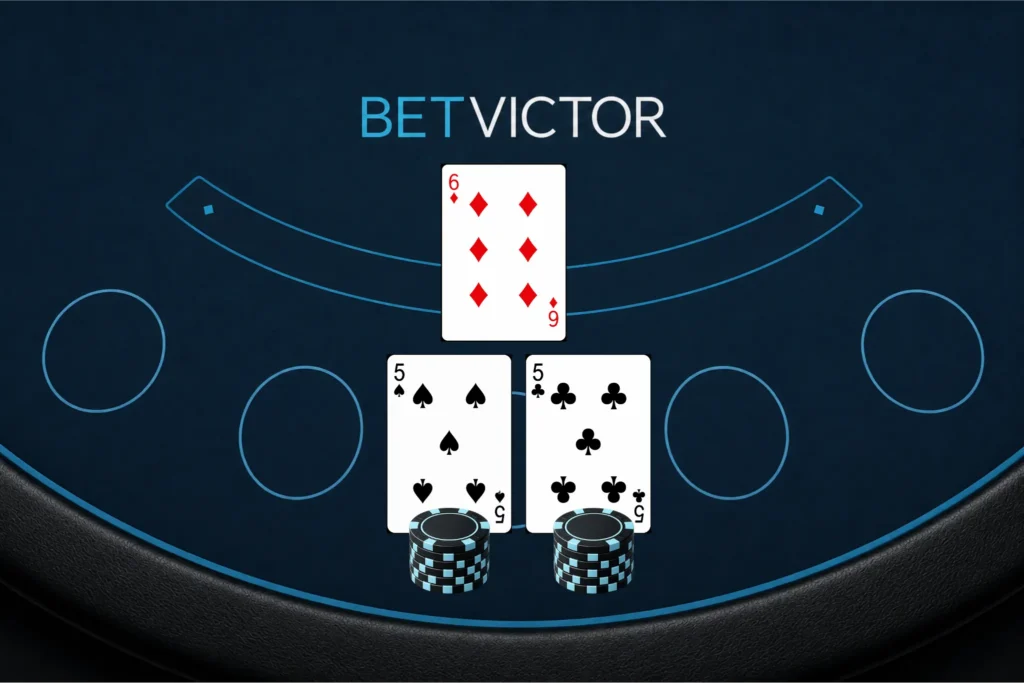
The dealer’s upcard of 6 is a weak card, dealers bust approximately 42% of the time from this position. Basic strategy says double your hard 10 against dealer 6.
- Doubling yields approximately +0.25 units expected value
- Splitting yields approximately -0.15 units expected value
You want to have as much value on the table as possible when the dealer is in a weak position and more likely to bust. A starting total of ten gives you a strong opportunity to build a competitive hand with a single draw, whereas splitting into two hands of five creates two weaker positions that require additional risk and stake. For that reason, keeping the hand together is generally the more sensible approach, as it allows you to take advantage of favourable dealer situations without increasing your overall exposure unnecessarily.
Example 2: Your 5-5 vs Dealer 10
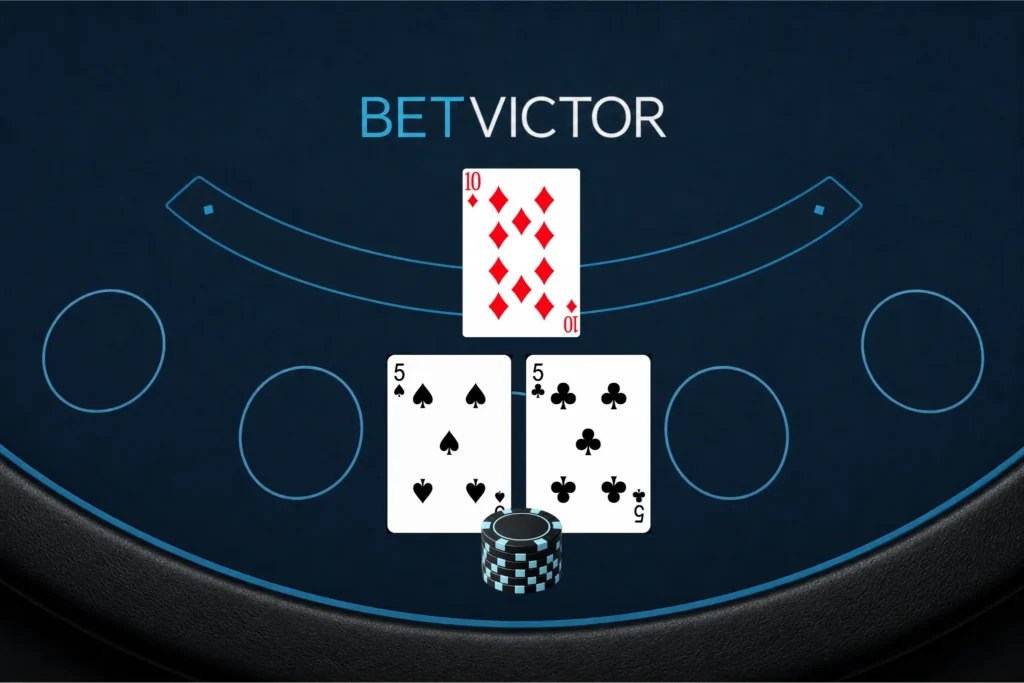
Against a face up card of 10, the dealer has a strong hand. Here, basic strategy recommends hitting your 10 (or doubling if table rules permit and your chart supports it).
- Hitting yields approximately +0.02 expected value
- Splitting yields approximately -0.10 expected value
Splitting into two 5s against a powerful dealer upcard puts you in a losing position twice. One solid 10 gives you the best chance.
Are There Any Exceptions for Splitting 5s?
Some advanced card counters using detailed index numbers might find extremely rare spots in multi-deck games where splitting carries a marginal edge. We’re talking about situations requiring true counts of +5 or higher with perfect counting, conditions that appear perhaps once in hundreds of hands.
Your default rule for European blackjack: never split 5s.
How you should Play 55 at the Table
| Dealer Shows | Your Play with 5-5 |
|---|---|
| 2 through 9 | Double (or hit if not allowed) |
| 10 or Ace | Hit (or double per your chart) |
| Any upcard | Never split |
Improving your results is less about mastering complex tactics and more about cutting out basic mistakes. A key example is playing a pair of 5s as a strong total of 10, rather than splitting into two weaker hands. Making this simple adjustment can help you approach European blackjack with a clearer, more consistent strategy. Remember, blackjack should always be played for enjoyment, not as a way to make money. Set limits, stay in control, and only play with funds you’re comfortable losing.