
Blackjack can leave you making several decisions in the space of one hand. Do you hit 16, stand on 12, split a pair or double down? Blackjack basic strategy takes much of the guesswork out of those choices by comparing your cards with the dealer’s visible card.
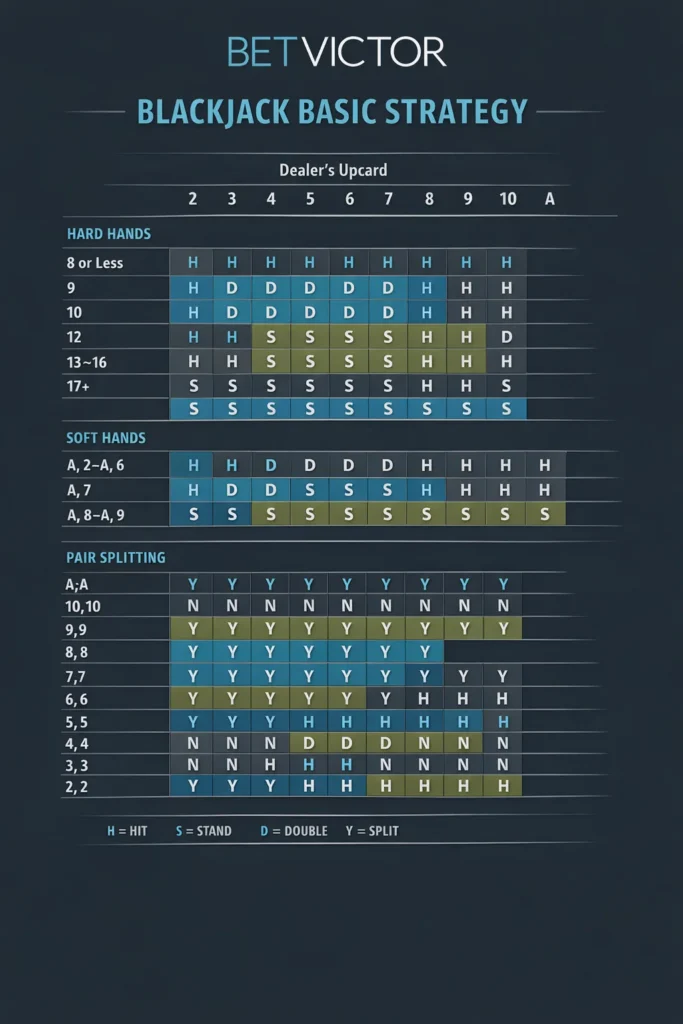
A blackjack basic strategy chart puts those decisions into one place. Find your hand down the side, match it with the dealer’s upcard and you’ll see the mathematically preferred play. Hard totals, soft hands and pairs are separated because the best move can change quite a bit between them.


A basic strategy chart gives you a quick way to check the best move for hard totals, soft hands and pairs without relying on instinct alone. That can be especially useful when playing live blackjack games, where decisions such as hitting, standing, splitting or doubling are made against a real dealer in real time. Just remember that individual tables can use slightly different rules, so the chart should always match the version of blackjack you’re playing.

Below is an example of a basic strategy chart.
Core Concepts: Hard Hands, Soft Hands, and Pairs
Before looking at any blackjack chart, recognise which hand type you’re holding:
- A hard total means any ace counts as 1 (or there’s no ace). Example: 10-6 equals hard 16.
- A soft total means an ace valued at 11 without busting. Example: A-7 equals soft 18.
- Pairs like 8-8 or 9-9 get separate hands treatment because splitting is often the optimal move.
Knowing your hand category is essential before making basic strategy decisions.
How a Basic Strategy Chart Works
A blackjack strategy chart is easier to read than it first appears. Start by finding your hand on the left, then move across to the dealer’s visible card. The square where the two meet shows the suggested action, whether that means hitting, standing, doubling down, splitting or surrendering if the game allows it.
The main thing is making sure you’re looking in the right part of the chart. A-7 is a soft 18 because the ace can still count as 11. A hand such as 10-8 is a hard 18, while two 8s belong in the pairs section rather than being treated as an ordinary 16.
Not every blackjack table uses identical rules, so one chart won’t always cover every game perfectly. Check the number of decks, the dealer’s soft-17 rule and any restrictions around doubling, splitting or surrender before relying on a particular blackjack basic strategy chart.
Does Blackjack Basic Strategy Change Between Games?
Yes. The basic idea stays the same, but individual decisions can change depending on the blackjack rules being used.
The number of decks matters, as does whether the dealer hits or stands on soft 17. Rules around doubling after a split, surrender and when the dealer checks for blackjack can also alter the mathematically preferred play.
European blackjack is a good example. In European no-hole-card games, the dealer usually waits until players have acted before taking a second card. That can affect certain splitting and doubling decisions against a dealer 10 or ace.
You don’t need a different approach every time you sit down. Just check the table rules and make sure the strategy chart you’re following is designed for a reasonably similar version of blackjack.

Key Basic Strategy Rules You Should Memorise First
Hard Totals
When you’re playing hard totals, the general rule is to stand on 17 or more. With 12, the decision depends on the dealer’s card. You should hit against 2 or 3, but stand when they show 4, 5 or 6. A hard 16 is one of the more difficult hands. Against stronger dealer cards from 7 through Ace, you will usually hit. Where surrender is available, the chart may recommend it in certain difficult situations. As the correct play depends on the rules of that particular game, it’s worth checking the relevant strategy chart rather than treating surrender as a universal blackjack rule.
Soft Totals
Soft hands are played slightly differently. With soft 13 to 17, doubling against a dealer 5 or 6 can be a useful option when allowed. Soft 18 needs a bit more care. You may double against 3 to 6, stand against 2, 7 or 8, and hit if the dealer shows 9, 10 or Ace.
Pairs
For pairs, aces and 8s are commonly split, while 5s and 10 value cards are usually kept together. Smaller pairs like 2s and 3s can be split against weaker dealer cards, and 9s are often split in certain spots but kept as 18 against a 7.
Blackjack Basic Strategy: What to Remember
Blackjack basic strategy is really about removing the avoidable guesswork. Work out whether you have a hard total, soft hand or pair, check the dealer’s upcard and use a chart suited to the rules of the game you’re playing.
You probably won’t memorise every decision straight away, and there’s no real need to. The common situations become easier to recognise with practice. If you want to go deeper into why different rules matter, our guide to the blackjack house edge explains how deck numbers, payouts and dealer rules can affect the maths.
Basic strategy shouldn’t be confused with card counting either. Strategy deals with the hand in front of you, whereas counting tries to keep track of cards that have already been dealt. Our new guide on how to count cards in blackjack explains the Hi-Lo system, running count and true count in more detail.
No blackjack strategy can guarantee a profit or remove the element of chance from an individual hand.