A pair of 9s gives you 18 before you’ve made a single decision. That sounds strong enough to leave alone, but blackjack basic strategy doesn’t always agree. In some spots you keep the 18; in others, splitting the pair gives you the better play.
The dealer’s upcard is what makes the difference. If you’re playing one of BetVictor’s live blackjack games, it’s worth checking the individual table rules first, but this guide follows the same European blackjack assumptions used across BetVictor’s current strategy content.

Quick Answer: Should You Split 9s in Blackjack?
Under the European basic strategy used in this guide:
- Split 9s against dealer 2, 3, 4, 5 or 6
- Stand against dealer 7
- Split against dealer 8 or 9
- Stand against dealer 10 or Ace
So, for the two examples in this guide:
- Player 9-9 vs dealer 7: Stand
- Player 9-9 vs dealer 8: Split
That might feel backwards at first. Eighteen is a decent hand, so why break it up against an 8 but keep it against a 7? The answer comes down to how your existing 18 matches up with the dealer’s likely finishing total.
BetVictor’s current blackjack basic strategy guidance follows the same 9-9 pattern.
Why Is a Pair of 9s Different From Other Pairs?
Two 9s are unusual because you already have a playable total before deciding whether to split.
With a pair of 8s, keeping the cards together leaves you with hard 16, which is a far more awkward hand. A pair of 9s gives you 18, so splitting has to offer a genuine strategic reason to justify breaking up something that is already reasonably strong.
That’s why the dealer card matters so much.
Against weaker upcards such as 4, 5 or 6, splitting gives you two chances to build hands while the dealer is in a vulnerable position. Against a dealer 7, keeping 18 intact makes more sense.
For comparison, our guide on whether you should split 8s in blackjack shows how a much weaker starting total can change the decision entirely.
Example 1: Player 9-9 vs Dealer 7
Suppose you’re dealt:
Player: 9-9
Dealer: 7
Your hand is worth 18.
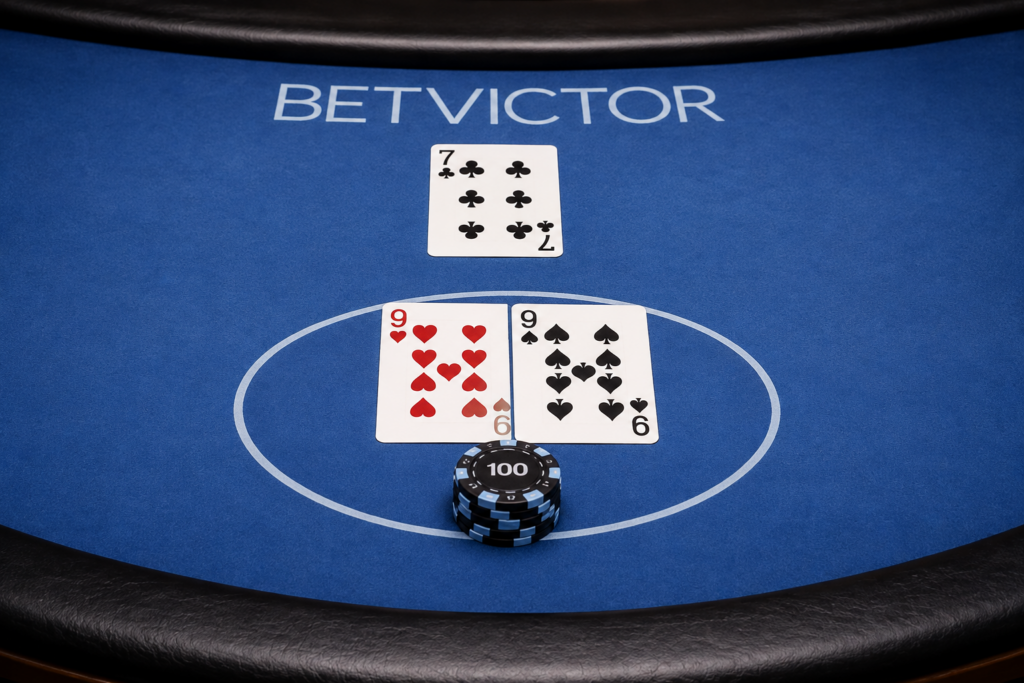
The basic-strategy move here is stand.
A dealer showing 7 has a realistic route to 17, and your existing 18 already beats that. Breaking the pair apart means giving up a perfectly useful total and placing another stake on the table to create two new hands that both start with 9.
There simply isn’t enough reason to do that in this spot.
If the dealer finishes on 17, your 18 wins. If they make 18, you can still push. Of course, the dealer may finish higher, but splitting doesn’t magically remove that risk.
This is one of those blackjack decisions where doing less is actually the better play. BV’s current pair-splitting chart also marks 9-9 vs dealer 7 as stand.
Example 2: Player 9-9 vs Dealer 8
Now change just one card:
Player: 9-9
Dealer: 8
You still have 18, but this time basic strategy says split.
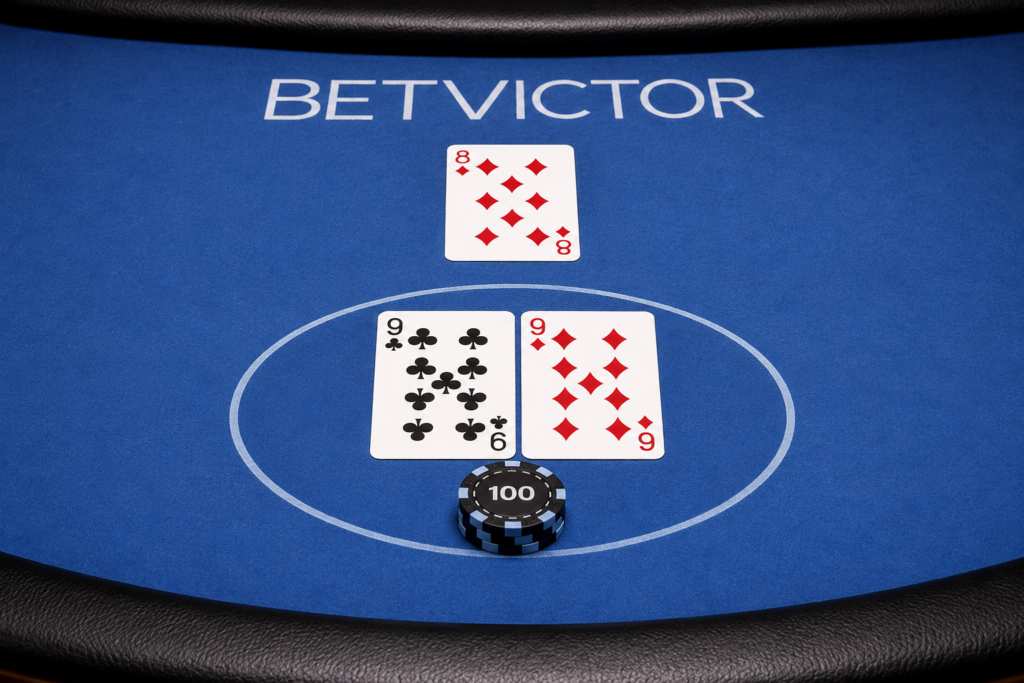
A dealer 8 puts more pressure on your total. Standing on 18 leaves you vulnerable to a dealer making 19, 20 or 21, and there’s less value in simply hoping your 18 survives.
Splitting creates two new hands that each begin with a 9. Draw a 10-value card and you have 19. An Ace gives you 20. Even smaller cards can leave room to build a stronger hand.
There’s no guarantee either split hand will improve, of course. The point is that the dealer’s 8 changes the balance enough for splitting to become the preferred basic-strategy decision.
That contrast between dealer 7 and dealer 8 is exactly why memorising “always split this pair” can get you into trouble.
When Should You Split 9s in European Blackjack?
For the rules used throughout this article, the quick reference is:
- Dealer 2: Split
- Dealer 3: Split
- Dealer 4: Split
- Dealer 5: Split
- Dealer 6: Split
- Dealer 7: Stand
- Dealer 8: Split
- Dealer 9: Split
- Dealer 10: Stand
- Dealer Ace: Stand
That pattern is also used in BetVictor’s broader guide on when to split in blackjack.
The dealer’s card is doing most of the work here. Against weaker upcards, splitting lets you press an advantage. Against 7, your existing 18 is already well placed. Against 8 or 9, splitting gives you a route away from an 18 that may not be strong enough.
Why Do You Stand on 9-9 Against a Dealer 7?
This is probably the most searched part of the decision because it feels strange to split 9s against several weaker cards, stop at 7, then start splitting again against 8 and 9.
The simple explanation is that 18 matches up nicely against a dealer 7.
A dealer beginning with 7 will often finish around the 17-21 range. Your 18 already beats 17 and ties another 18, so there’s no need to turn one reasonable hand into two uncertain ones.
If you split, each new hand starts at 9 and needs another card before it becomes competitive.
Standing keeps the value you already have.
Why Do You Split 9s Against a Dealer 8?
Against an 8, your 18 becomes less comfortable.
The dealer has a stronger starting position, and simply standing leaves you with limited upside. Splitting gives each 9 a fresh card and creates two chances to reach 19, 20 or 21.
It still increases the amount you have on the table, because splitting requires another bet equal to your original stake. That is why the move should come from basic strategy rather than instinct.
It’s not a case of “18 is bad against 8”. It’s that splitting the pair is considered the better long-term decision under the rules assumed here.
What Happens When You Split 9s?
Splitting 9s works like any normal pair split.
You place a second stake equal to the original bet, then the dealer separates the cards into two hands. Each 9 receives another card and you play those hands separately.
Depending on the table rules, you may then be able to:
- Hit
- Stand
- Double after splitting
- Split again if another 9 appears
The available options vary from one blackjack game to another, which is why checking the rules before playing matters.
Do You Always Split 9s in Blackjack?
No. Unlike Aces or some other commonly discussed pairs, 9s are very dependent on the dealer’s upcard.
Under the European basic strategy covered here, you split against 2-6, 8 and 9, then stand against 7, 10 and Ace.
That makes 9-9 a useful example of why pair strategy can’t always be reduced to one memorable rule.
If you’re unsure whether you should split, stand or hit a particular hand, the BetVictor blackjack strategy section brings those decisions together in one place.