A pair of 8s is one of those blackjack hands that looks simple until the dealer turns over their upcard. Together, the cards make a hard 16, which is hardly a comfortable total to work with. In many situations, splitting gives you a better way forward, but there are exceptions depending on the blackjack rules being used.
For this guide, we’re looking at European no-hole-card blackjack, where the dealer takes their second card after players have acted and additional split or double stakes can be lost if the dealer makes blackjack. That detail matters. If you’re playing one of BetVictor’s live blackjack games, check the individual table rules before applying any strategy.

Quick Answer: Should You Split 8s in Blackjack?
Under the European no-hole-card rules used in this guide, split 8s when the dealer shows 2 through 9.
Against a dealer 10 or Ace, hit instead of splitting.
So, for the two examples we’re focusing on:
- Player 8-8 vs dealer 5: Split
- Player 8-8 vs dealer 10: Hit, do not split
That may look different from some blackjack charts online. There’s a reason for that, which we’ll get into shortly.
Why Is a Pair of 8s Such an Awkward Blackjack Hand?
Two 8s give you a hard 16. Keeping the pair together means you’re already sitting on one of the most uncomfortable totals in blackjack.
Stand and a dealer making 17 or better beats you. Hit and any 6, 7, 8, 9 or 10-value card sends the hand over 21.
Splitting can get you out of that position. Instead of one hard 16, you begin two separate hands with an 8 on each. You’ll need to place another stake equal to the original bet, then play both hands independently.
That’s why 8s feature so prominently in blackjack basic strategy. The idea isn’t that splitting guarantees a good result. It simply gives you a stronger mathematical option in many situations.
Do You Split 8s Against a Dealer 5?
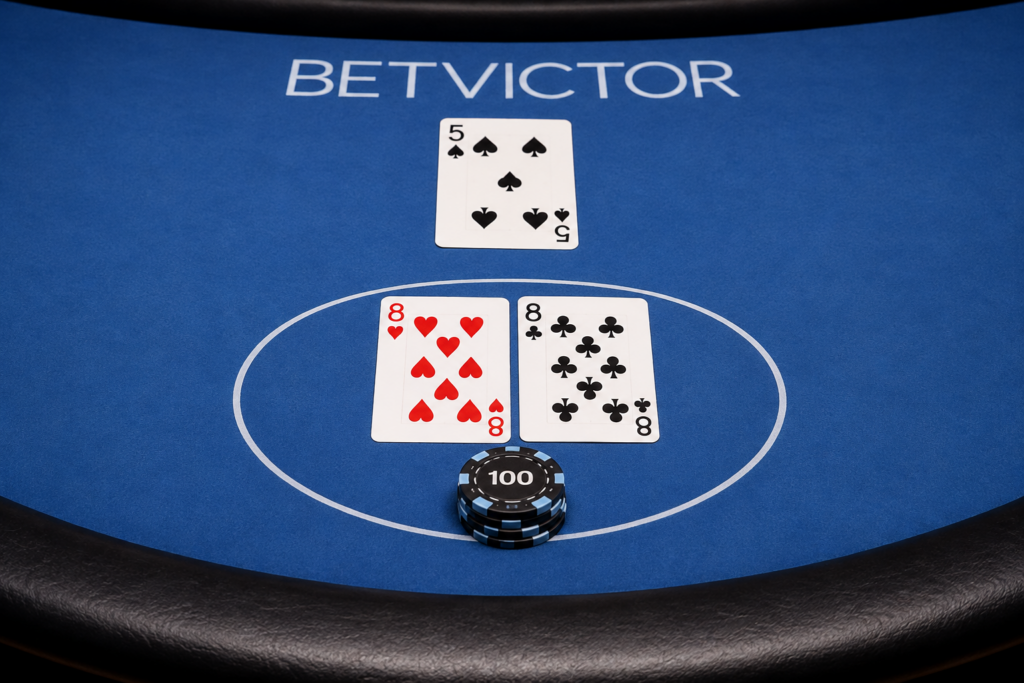
Yes. Split 8-8 against a dealer 5.
This is one of the more straightforward decisions.
A dealer 5 is considered a weak upcard because there are plenty of ways for the dealer to reach a difficult total before having to draw again. Keeping your 16 intact wastes an opportunity to turn one poor starting hand into two hands that each begin with an 8.
Imagine the cards are:
Player: 8♠ 8♦
Dealer: 5♣
The basic-strategy decision is split.
After splitting, each 8 receives another card. You could suddenly be looking at an 8-10 for 18 on one hand and an 8-3 for 11 on the other, for example. What you do next depends on the cards dealt and the table’s rules around doubling after a split.
The important bit is the original decision. Against a 5, you don’t want to sit on hard 16 if splitting is available.
Do You Split 8s Against a Dealer 10?
This is where the rules make a real difference.
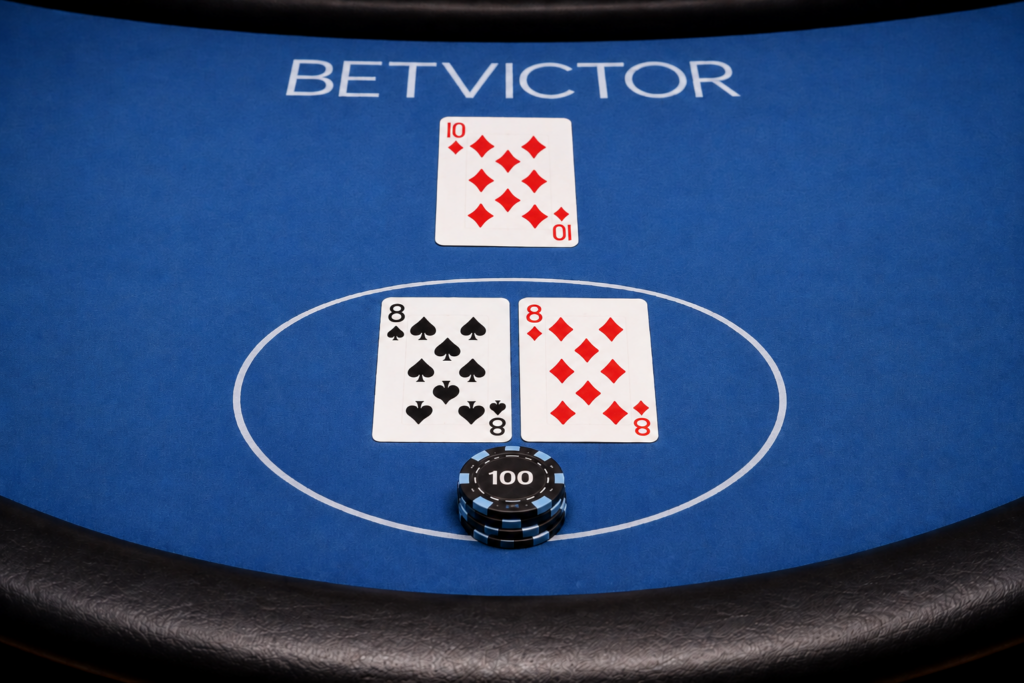
Under the European no-hole-card rules assumed in this article, you should not split 8s against a dealer 10. Hit the hard 16 instead.
Suppose you have:
Player: 8♣ 8♥
Dealer: 10♦
At a no-hole-card table, the dealer hasn’t yet checked whether that 10 is paired with an Ace. If you split, you put another full stake onto the table before knowing whether the dealer already has blackjack.
If the dealer later draws an Ace and the rules state that all additional split stakes are lost to blackjack, you lose both bets. That extra exposure changes the maths. Wizard of Odds’ European no-hole-card analysis specifically identifies 8-8 against a dealer 10 or Ace as a hand that should be hit rather than split under this type of rule.
It’s not because hard 16 suddenly becomes a nice hand. It doesn’t. Hitting is simply the less costly basic-strategy choice under those particular rules.
When Should You Split 8s in European Blackjack?
For the ENHC rules used here, the simple version is:
- Dealer 2: Split
- Dealer 3: Split
- Dealer 4: Split
- Dealer 5: Split
- Dealer 6: Split
- Dealer 7: Split
- Dealer 8: Split
- Dealer 9: Split
- Dealer 10: Hit
- Dealer Ace: Hit
The maths behind those decisions can shift when the rules change. Number of decks, surrender, doubling after a split and what happens to extra wagers when the dealer has blackjack can all matter.
For a broader look at every pair rather than just eights, our guide to when to split in blackjack covers the rest of the common decisions.
Why Do Some Blackjack Charts Say You Should Always Split 8s?
Search for “do you split 8s in blackjack?” and you’ll probably find plenty of charts telling you to always split Aces and 8s.
Those charts aren’t necessarily wrong. They may simply be based on a different game.
In many American-style blackjack games, the dealer checks for blackjack before players decide whether to split or double. If the dealer has blackjack, the round ends before you’ve put extra money behind a split. Under those conditions, splitting 8s against a dealer 10 is commonly the basic-strategy play.
European no-hole-card blackjack can work differently. The dealer waits to take their second card, so splitting against a 10 can expose an additional stake to a possible blackjack. Wizard of Odds notes that ENHC players need to be more conservative when doubling or splitting against a dealer 10 or Ace for exactly this reason.
So when two strategy charts disagree, check the rules they were built for before assuming one of them is wrong.
What Happens When You Split 8s?
Splitting turns your original pair into two separate blackjack hands.
You place another bet equal to your starting stake, the dealer separates the two 8s and each receives a new card. From there, you play one hand and then the other.
Depending on the game, you may be able to:
- Hit either hand
- Stand
- Double after splitting
- Split again if another 8 appears
Rules vary between tables, particularly around resplitting and doubling after a split, so it’s worth checking before the first hand is dealt.
Do You Always Split 8s in Blackjack?
No.
“Always split 8s” is a useful shortcut for some blackjack variants, but it isn’t universal.
Under the European no-hole-card setup covered here, 8-8 should be split against dealer cards 2 through 9, then hit against a 10 or Ace. In a blackjack game where the dealer checks for blackjack before you act, the correct decision can be different.
That’s why the table rules matter just as much as the cards.
Final Verdict: Should You Split a Pair of 8s?
A pair of 8s leaves you with hard 16, and there aren’t many comfortable ways to play that total. Against a dealer 5, the answer is clear: split the 8s and play the two new hands separately.
Against a dealer 10, it depends on the game. Under the European no-hole-card rules used throughout this guide, hit rather than split, because the extra split stake can be exposed if the dealer later completes blackjack.
If you want to explore more decisions like this, BetVictor’s blackjack strategy section covers splitting, doubling, basic strategy and other common situations at the table.
No blackjack strategy guarantees a winning hand or session. Basic strategy is about making the mathematically preferred decision for the rules in front of you, not removing chance from the game.