Knowing when to stand in blackjack is crucial, especially in European Blackjack where the dealer stands on all 17s. Using basic strategy, you stand on totals of 17 or more and you also stand on hard 13 to 16 when the dealer shows a weak card like 2 to 6. This article explains every situation where standing is the correct move, based on optimal basic strategy for European rules.
Optimal Times to Stand in Blackjack
Standing is the preferred choice when your hand is strong, and the dealer’s upcard is weak (2-6), which suggests a high likelihood of them busting or having a weaker hand. In these situations, you have a good chance of winning if you stand. Here are some guidelines on when to stand:
- You should stand on hard hands (hands without an Ace) of 17 or more because these totals are already strong, and taking another card greatly increases your chance of busting.
- Stand on soft hand totals (hands with an Ace counted as 11) of 18 or higher, unless basic strategy suggests otherwise.
- If your hand totals 13-16 and the dealer shows a weak upcard (2-6), stand, as the dealer is more likely to bust.
Remember, drawing other cards increases your total and risk, so standing is often safer with strong hands or when the dealer is at a disadvantage
The table below shows the full European Blackjack basic strategy chart, with every correct stand action highlighted in bold. This makes it easy to see exactly when you should stand based on your hand and the dealer’s upcard, helping you follow optimal strategy and reduce the house edge. Use this simplified chart as a quick reference guide for European Blackjack, where the dealer stands on all 17s.
| Your Hand | Dealer’s Hand | Correct Play |
|---|---|---|
| 8 or less | Any | Hit |
| 9 | 3–6 | Double |
| 9 | 2, 7–A | Hit |
| 10 | 2–9 | Double |
| 10 | 10–A | Hit |
| 11 | 2–10 | Double |
| 11 | A | Hit |
| 12 | 4–6 | Stand |
| 12 | 2–3, 7–A | Hit |
| 13–16 | 2–6 | Stand |
| 13–16 | 7–A | Hit |
| 17+ | Any | Stand |
| A2–A3 | 4–6 | Double (else Hit) |
| A2–A3 | 2–3, 7–A | Hit |
| A4–A5 | 4–6 | Double (else Hit) |
| A4–A5 | 2–3, 7–A | Hit |
| A6 | 3–6 | Double (else Hit) |
| A6 | 2, 7–A | Hit |
| A7 | 2, 7–8 | Stand |
| A7 | 3–6 | Double |
| A7 | 9–A | Hit |
| A8–A9 | Any | Stand |
| 2,2 | 2–7 | Split |
| 2,2 | 8–A | Hit |
| 3,3 | 2–7 | Split |
| 3,3 | 8–A | Hit |
| 4,4 | 5–6 | Split |
| 4,4 | Other | Hit |
| 5,5 | 2–9 | Double |
| 5,5 | 10–A | Hit |
| 6,6 | 2–6 | Split |
| 6,6 | 7–A | Hit |
| 7,7 | 2–7 | Split |
| 7,7 | 8–A | Hit |
| 8,8 | Any | Split |
| 9,9 | 2–6, 8–9 | Split |
| 9,9 | 7, 10, A | Stand |
| 10,10 | Any | Stand |
| A,A | Any | Split |
Now that you’ve seen the basic strategy chart, we’ll look at some clear examples of when you should stand in blackjack, using simple visuals to make each decision easy to follow. These examples are based on standard blackjack rules and focus on the most common hit or stand scenarios you’ll face at the table. By seeing these situations visually, you’ll better understand why standing is the correct move in specific hands and how to apply the strategy in real play.
Always Stand with a Hard 17 or Higher
When your hand has a total of 17 or higher and does not contain an ace that can be counted as 11 (known as a hard hand), it’s usually best to stand. In blackjack, it’s important to distinguish between soft and hard hands, soft hands contain an ace that can be valued as 1 or 11, offering more flexibility, while hard hands do not. This distinction influences your strategy. Additionally, your decision should also consider the dealer’s card, as what the dealer shows can affect whether standing is the optimal move. This is because the chances of busting with a high hand are relatively high, and standing puts the pressure on the dealer to beat your strong hand.
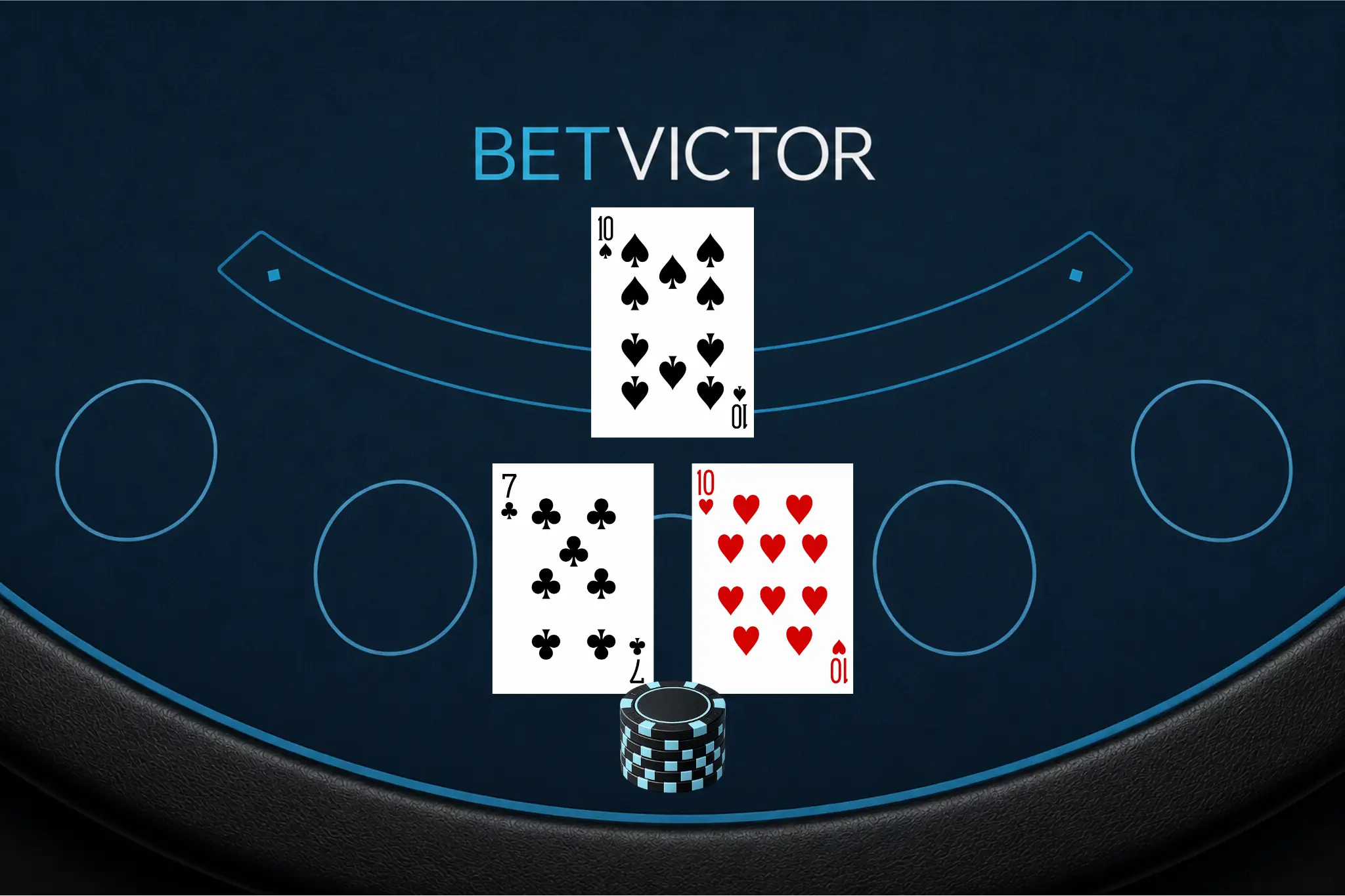
An example would be a Player Hard 17 vs a Dealer 10
When you have 17 and the dealer is showing a 10, the correct play is to stand.
Under standard blackjack rules, any total of 17 or higher is considered a made hand. If you hit on 17, you have a very high chance of busting because any card valued 5 or higher will take you over 21. Even if you draw a small card, you’re unlikely to improve your hand enough to beat the dealer.
Standing keeps your 17 intact and forces the dealer to complete their hand. Since the dealer must hit until they reach at least 17, there is always a chance they will bust or finish on the same total, resulting in a push. Over the long run, standing on 17 against a dealer 10 follows basic strategy and minimises the house edge compared to hitting.
Stand When the Dealer’s Upcard is Weak
If the dealer’s upcard is a 2 through 6, standing with a hand value of 12 or higher is often a good strategy. In this situation, the dealer is in a challenging position with a weak hand, and there’s a higher likelihood of them busting as they have to take at least 2 cards.
In some cases, instead of standing, players may choose to split pairs into separate hands—especially with aces—to maximize their chances. Splitting aces is a common strategy to create two strong starting hands with a value of 11, particularly when the dealer shows a weak upcard.
An example would be a Player Hard 15 vs a Dealer 5
When you have a hard 15 and the dealer is showing a 5, the correct play is to stand.
Under standard blackjack rules, a dealer 5 is considered a weak upcard. The dealer must continue to hit until reaching at least 17, and starting from a 5 gives them a high chance of drawing multiple cards and busting. By standing on 15, you avoid risking your own hand and allow the dealer’s weakness to work in your favour.
If you hit on 15, you introduce unnecessary risk, as any card valued 7 or higher will cause you to bust. While your total is not strong, basic strategy shows that standing leads to better long-term results because the dealer is more likely to go over 21 when starting from a 5. For this reason, standing on 15 against a dealer 5 is the optimal decision.
Stand with Soft 18 or Higher
Soft hands are flexible because the Ace can count as 1 or 11, but that doesn’t mean you should always hit. Once a soft hand reaches 18 or more, the chance of improving enough to beat the dealer is low, while hitting can reduce your total or force you into weaker follow-up decisions. Standing in these spots follows basic blackjack strategy and minimises the house edge over time.
Stand on These Soft Hands
- Soft 19 or higher (A8, A9)
Always stand. These are strong hands and hitting offers little upside. - Soft 18 (A7)
Stand when the dealer shows 2, 7, or 8.
In these situations, your 18 is competitive, and hitting risks turning a good hand into a weaker one.
Standing Strategies in Online and Live Dealer Blackjack
The decision to stand remains consistent whether you’re playing blackjack at an online casino with an online blackjack dealer or at a live dealer table. In both settings, the fundamental rules of when to stand apply. The primary differences between the two are the convenience of online play and the immersive experience of a live dealer setting.
Summary: Avoiding Common Mistakes
Many players fall into the trap of making decisions based on hunches rather than following a proven blackjack strategy. One of the most common mistakes is ignoring the basic strategy chart, which can lead to hitting or standing at the wrong times and increasing the house edge. Another frequent error is poor bankroll management, which can result in chasing losses or making bets that are too large for your budget. To avoid these pitfalls, it’s important to practice regularly, use a blackjack strategy chart, and always be mindful of the dealer’s upcard. For example, if the dealer is showing a weak card like a 4 or 5, standing with a hand total of 13 or higher is often the best move. Conversely, if the dealer’s upcard is an ace or a high value card, you may need to hit to improve your chances. By staying disciplined, following the strategy chart, and adjusting your play based on the dealer’s hand you can avoid common mistakes.