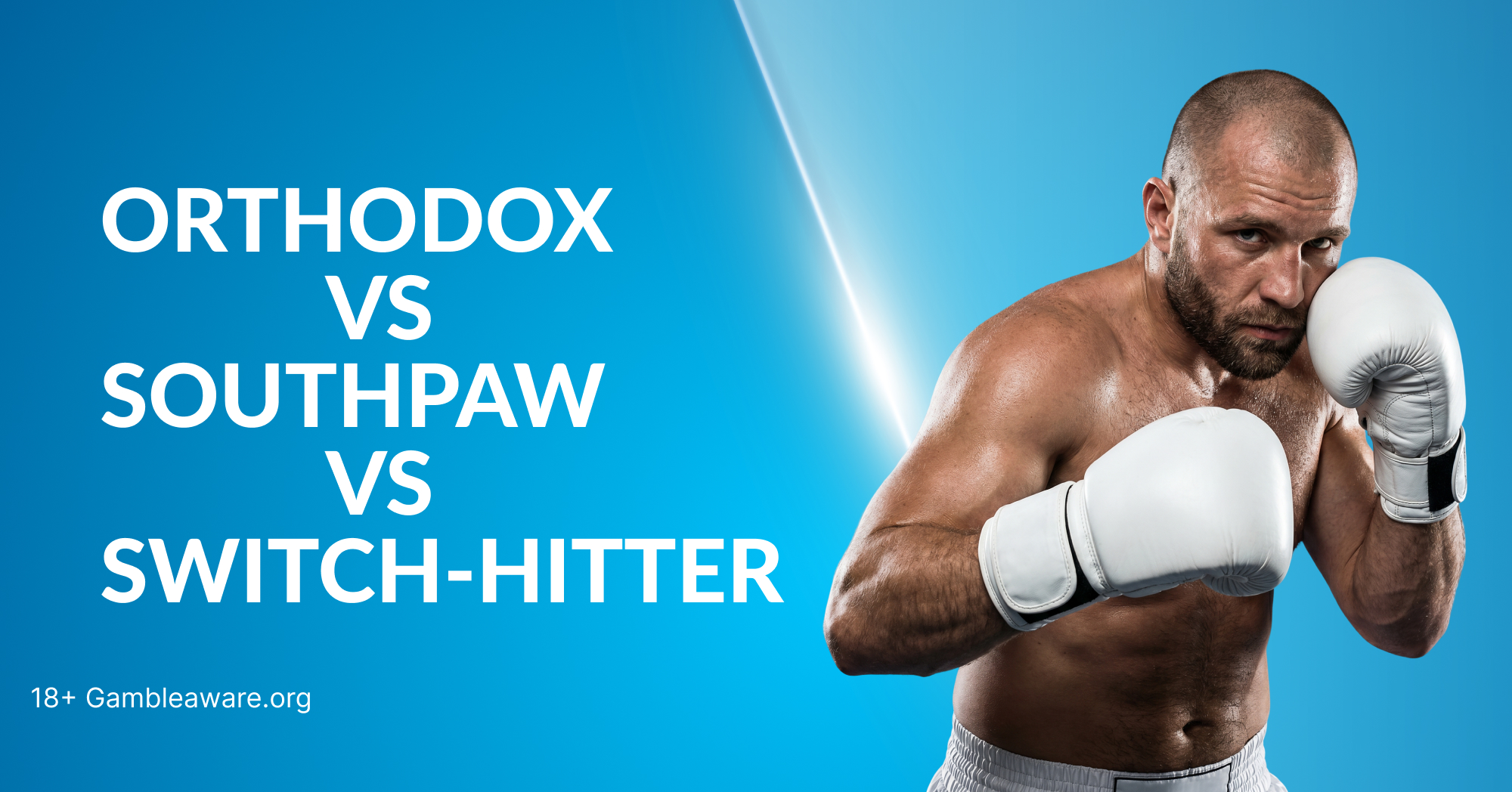
Stance is the foundation of every boxing match. The way a fighter stands shapes their footwork, their power generation, their defence, and the angles they can land punches from. Watch any professional bout and you will see two boxers locked into one of three positions: orthodox, southpaw, or switch-hitting between the two.
The orthodox stance is the most common in boxing and the natural choice for right-handed fighters. The southpaw stance is the mirror image and the preferred position for left-handed boxers. Switch-hitters are the rare technicians who can fight competently from both stances, swapping mid-round to confuse opponents and exploit angles.
This guide breaks down each stance in detail, explains how the matchups play out in the ring, and looks at the most famous fighters who have mastered each style throughout boxing history.
What Is the Orthodox Stance in Boxing?
The orthodox stance is the standard fighting position in boxing. A right-handed boxer stands with their left foot forward, left side closer to the opponent, and right hand in the rear position. The left hand operates as the lead jab, while the more powerful right hand stays back ready to deliver the cross.
Roughly 70 to 95 per cent of the population is right-handed, which explains why the orthodox stance dominates the sport. Most boxing coaches teach orthodox by default, most sparring partners use orthodox, and most professional fighters compete in this position throughout their careers.
Key Advantages of the Orthodox Stance
- Power delivery: Power delivery: The dominant right hand sits in the rear position, generating maximum rotation and force when thrown.
- Familiar coaching: Familiar coaching: Orthodox technique has been refined over more than a century of boxing instruction.
- Sparring access: Sparring access: Most training partners fight orthodox, giving easy access to skill development.
- Body shot angles: Body shot angles: The left lead foot positions the boxer to attack the opponent’s exposed right side, particularly the liver.
- Defensive stability: Defensive stability: A right-side dominant fighter keeps their stronger leg in the back, providing better balance under pressure.
The orthodox stance is not necessarily a left-handed boxer’s enemy, either. Some left-handers choose to fight orthodox so their stronger left hand operates as a faster, more dangerous lead jab. Vasyl Lomachenko is the obvious modern example of a left-hander who fights southpaw, while Oscar De La Hoya was a southpaw amateur who switched to orthodox as a professional and went on to win world titles in six different weight divisions.
What Is the Southpaw Stance in Boxing?
The southpaw stance is the mirror image of orthodox. A southpaw fighter stands with their right foot forward, right side closer to the opponent, and left hand in the rear position. The right hand acts as the lead jab, while the dominant left hand stays back ready to throw the power cross.
Most southpaws are naturally left-handed. The stance positions their stronger left hand in the rear power slot, giving them the same rotational power benefit that orthodox boxers get from their dominant right hand. Some right-handed boxers also choose southpaw deliberately to confuse opponents or to keep their stronger lead hand close to the opponent for snappy jabs.
Key Advantages of the Southpaw Stance
- Rarity advantage: Rarity advantage: Most boxers spend their careers training against orthodox opponents and struggle when facing a southpaw.
- Awkward angles: Awkward angles: The reversed stance creates unfamiliar punching angles that orthodox fighters cannot easily anticipate.
- Counter-punching opportunities: Counter-punching opportunities: Southpaws can exploit overextended orthodox jabs with straight left counters down the middle.
- Open-stance liver shots: Open-stance liver shots: When a southpaw faces an orthodox boxer, the southpaw’s lead right hand has a direct path to the orthodox fighter’s exposed liver.
- Adaptation advantage: Adaptation advantage: Southpaws constantly spar against orthodox opponents, so they are far better prepared for mixed-stance matchups than their orthodox counterparts.
The rarity factor is the biggest competitive edge southpaws bring to the ring. Boxing studies have consistently shown that orthodox fighters perform measurably worse against southpaws than they do against other orthodox boxers. The unfamiliarity creates defensive gaps that a skilled southpaw can exploit again and again across 12 rounds.
Where Does the Term “Southpaw” Come From?
The word “southpaw” originates from late 19th-century American baseball rather than boxing. In the early days of professional baseball, ballparks were typically built so the batter faced east, putting the afternoon sun behind them and out of their eyes. A left-handed pitcher therefore threw with his pitching arm on the south side of the diamond.
Sportswriters started calling left-handed pitchers “southpaws” sometime in the 1880s. The nickname crossed over into boxing within a couple of decades and stuck as the universal description for left-handed fighters. Modern boxing has fully absorbed the term, and you will hear commentators describe a fighter as a “southpaw” without any reference to the baseball origin.
What Is a Switch-Hitter in Boxing?
A switch-hitter is a boxer who can fight competently from both orthodox and southpaw stances and switch between them during a fight. True switch-hitting is one of the rarest skills in boxing because it requires elite-level footwork, ambidextrous punching power, and the ring intelligence to know exactly when a switch creates an advantage.
Some switch-hitters change stances multiple times per round. Others pick the stance they believe gives them the best matchup against a specific opponent and stick with it for the entire fight. Both approaches can work at the highest level, but the unpredictability of constant switching is what makes the technique so dangerous.
Why Boxers Switch Stances Mid-Fight
- Confusion: Confusion: A sudden stance change disrupts the opponent’s defensive timing and rhythm.
- Angle creation: Angle creation: Switching opens new attacking lanes that were not available from the previous stance.
- Energy conservation: Energy conservation: Some fighters switch to relieve a tired lead leg or shoulder.
- Injury management: Injury management: A cut or hand injury can force a temporary stance change.
- Tactical advantage: Tactical advantage: Specific opponents have known weaknesses against one stance over the other.
Switch-hitting demands enormous training investment. Boxers who switch effectively have built genuine punching power from both hands, comfortable footwork in both directions, and the muscle memory to execute defensive movements from either stance. Most professional boxers never develop true switch-hitting because the time required would distract from refining their primary stance.
Orthodox vs Southpaw: How the Matchup Plays Out
When an orthodox fighter faces a southpaw, the matchup is called an “open stance” exchange. Both boxers have their power hands on the same side as their opponent’s power hand. This alignment creates a chess match that revolves around two tactical questions: who controls the outside lead foot, and who lands the power cross first?
The Outside Foot Battle
In any open-stance matchup, the boxer whose lead foot is positioned on the outside of their opponent’s lead foot gains a significant advantage. The outside foot position lines up the rear power hand directly with the opponent’s chin, while keeping the boxer’s own chin angled away from the opponent’s power hand.
Watch any high-level orthodox vs southpaw fight and you will see both boxers constantly stepping and pivoting to win outside foot dominance. The fighter who controls this battle controls the angles, and the angles decide the fight.
Orthodox Tactics Against a Southpaw
- Circle left: Circle to the left to avoid the southpaw’s straight left.
- Right hand over: Throw the right hand over the southpaw’s lead jab rather than around it.
- Lead hook: Use the lead left hook to the body to attack the southpaw’s exposed right side.
- Lateral footwork: Step laterally to break the southpaw’s rhythm and create new angles.
Southpaw Tactics Against an Orthodox
- Circle right: Circle to the right to stay outside the orthodox right hand.
- Straight left counter: Throw the straight left down the middle when the orthodox boxer extends their jab.
- Liver shots: Attack the orthodox fighter’s liver with the lead right hook.
- Lateral pivots: Use lateral movement to keep the orthodox boxer reaching and missing.
Famous Orthodox Boxers Through History
The orthodox stance has produced the majority of boxing’s greatest champions. The list of legendary orthodox fighters reads like a who’s who of the sport itself.
All-Time Great Orthodox Boxers
- Sugar Ray Robinson: Sugar Ray Robinson: Widely considered the greatest pound-for-pound boxer of all time. Retired with a 174-19-6 record across welterweight and middleweight.
- Muhammad Ali: Muhammad Ali: Three-time heavyweight world champion and the most famous boxer in history. Famous for his stinging jab and powerful right cross.
- Floyd Mayweather Jr: Floyd Mayweather Jr: Retired 50-0 with five-division world title success. Mastered the Philly shell defensive guard from the orthodox stance.
- Mike Tyson: Mike Tyson: Heavyweight world champion known for explosive orthodox power and the peek-a-boo style created by trainer Cus D’Amato.
- Lennox Lewis: Lennox Lewis: British orthodox heavyweight who unified the WBC, WBA, and IBF titles and defeated Holyfield, Tyson, and Vitali Klitschko.
- Anthony Joshua: Anthony Joshua: Modern British orthodox heavyweight world champion with knockout wins over Klitschko, Pulev, and Povetkin.
Famous Southpaw Boxers Through History
Southpaws are statistically rarer than orthodox fighters, but the southpaw ranks include some of boxing’s most accomplished and beloved champions.
All-Time Great Southpaw Boxers
- Manny Pacquiao: Manny Pacquiao: Filipino legend and the only boxer to win world titles across eight different weight divisions. His explosive southpaw angles defined an era.
- Marvin Hagler: Marvin Hagler: One of the greatest middleweights ever. Held the undisputed middleweight title for six years across the early 1980s.
- Pernell Whitaker: Pernell Whitaker: Defensive genius and four-division world champion. Considered one of the most technically gifted southpaws in history.
- Oleksandr Usyk: Oleksandr Usyk: Current Ukrainian heavyweight king. Beat Anthony Joshua twice, Tyson Fury twice, and Daniel Dubois to become undisputed heavyweight champion.
- Joe Calzaghe: Joe Calzaghe: Welsh super middleweight legend who retired undefeated at 46-0. The longest-reigning super middleweight world champion in boxing history.
- Naseem Hamed: Naseem Hamed: Sheffield-born featherweight world champion with the most unorthodox southpaw style boxing has ever seen. Retired 36-1.
- Gervonta Davis: Gervonta Davis: Modern American southpaw world champion across three weight divisions. Knockout power that few lightweights in history can match.
Famous Switch-Hitters in Boxing History
True switch-hitting is rare. Only a handful of fighters in any era develop the skills to compete at world level from both stances. The names below represent the gold standard.
Notable Boxing Switch-Hitters
- Tyson Fury: Tyson Fury: The Gypsy King is one of the most accomplished modern switch-hitters. At 6 foot 9 inches, Fury switches stances constantly to confuse heavyweight opponents.
- Marvin Hagler: Marvin Hagler: Although primarily a southpaw, Hagler was a genuine switch-hitter who could move seamlessly between stances mid-round.
- Terence Crawford: Terence Crawford: Three-division world champion who fights orthodox by default but switches to southpaw at the highest level when the fight demands it.
- Andre Ward: Andre Ward: Retired undefeated as a two-division world champion. Ward used stance switching to control the pace against bigger, stronger opponents.
- Naseem Hamed: Naseem Hamed: Switched stances constantly during fights, knocking opponents out with power punches from either hand.
Switch-hitting is also more common in mixed martial arts than in boxing. Conor McGregor, Anderson Silva, and Jon Jones all built MMA careers around stance versatility. The shorter rounds and additional weapons in MMA make switch-hitting more practical than the pure pugilistic switch-hitting of boxing.
British Southpaws and Switch-Hitters: A Proud Tradition
British boxing has a particularly strong tradition of southpaw and switch-hitting world champions. The list of UK and Irish fighters who have used these stances to win world titles is genuinely impressive.
Britain’s Greatest Southpaw Boxers
- Joe Calzaghe: Joe Calzaghe (Welsh): The undisputed king of British southpaws. Retired 46-0 with the WBO super middleweight belt for over 10 years and 21 successful defences.
- Naseem Hamed: Naseem Hamed (English): Sheffield’s Prince Naseem revolutionised British boxing with his unorthodox southpaw style and knockout power at featherweight.
- Ken Buchanan: Ken Buchanan (Scottish): Edinburgh’s southpaw legend won the WBA and WBC lightweight titles in the early 1970s and was inducted into the International Boxing Hall of Fame.
- Katie Taylor: Katie Taylor (Irish): Modern Irish boxing icon and undisputed lightweight world champion who used her southpaw stance to dominate women’s boxing for years.
- Joshua Buatsi: Joshua Buatsi (English): Current British orthodox light heavyweight (actually orthodox, but worth following).
Britain’s Most Famous Switch-Hitter
Tyson Fury is the British boxer most associated with switch-hitting at the highest level of the sport. The Gypsy King keeps opponents guessing with smooth footwork, sudden stance switches, and a constant barrage of feints. His hybrid style proved so effective that he beat Deontay Wilder twice, dethroned Wladimir Klitschko, and held the WBC heavyweight title for years before losing both fights to Oleksandr Usyk.
Why Stance Still Matters in Modern Boxing
The orthodox vs southpaw question is more relevant than ever in 2026. The current heavyweight landscape features Oleksandr Usyk (southpaw) sitting at the top of the division, with Tyson Fury (switch-hitter) and Anthony Joshua (orthodox) chasing his crown. The pound-for-pound rankings are dominated by southpaws including Naoya Inoue, Shakur Stevenson, and Jesse Rodriguez.
British heavyweight prospect Moses Itauma fights from the orthodox stance, while the wider British heavyweight scene includes both orthodox bruisers and clever switch-hitters competing for spots in the world title picture. Understanding stance is no longer optional knowledge for serious boxing fans.
Final Thoughts on Boxing Stances
Stance is one of the deepest tactical layers in boxing. The orthodox stance gives right-handed fighters the most natural setup, the southpaw stance gives left-handed boxers a rare-edge tactical weapon, and switch-hitting represents the highest level of in-ring craft. Neither stance is objectively better than the other. The right stance is the one that fits the individual fighter’s natural strengths, training history, and tactical preferences.
Whether fighting from orthodox or southpaw, every championship boxer trains to perform across the full 12 rounds of a world title fight. For the complete breakdown of round length, fight duration and how the championship distance has evolved, read our guide on how long is a boxing round.
For more boxing guides and analysis from the BetVictor team, head to the BetVictor boxing news hub or check the latest boxing odds at BetVictor for upcoming fights.
You can also explore our companion guides on boxing weight classes, the pound-for-pound rankings 2026, undisputed champions in the four-belt era, and the top 10 greatest British heavyweights of all time.