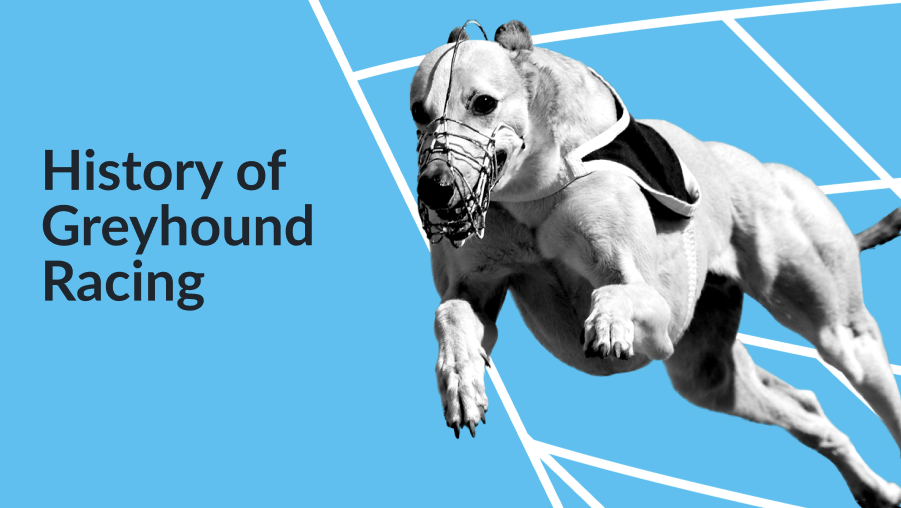
Greyhound racing has developed much over the last century and a half, with even BetVictor having a part to play in its history in Great Britain. We go through a timeline starting from the origins of the breed all the way up to the advent of online greyhound betting.
The Greyhound is one of the oldest recognisable breeds of dogs, with origins dating back thousands of years. Archaeological findings, including skeletal remains discovered at Tell Brak in modern Syria, suggest that dogs resembling the Greyhound and Saluki existed around 4,000 years ago.
Historical literature, notably by Arrian, mentions the vertragus, believed to be the first recorded sighthound in Europe and a potential ancestor of the Greyhound. The vertragus is thought to have originated from the Celts of Eastern Europe or Eurasia.
However, systematic archaeozoology research conducted in Britain in 1974 refuted the presence of a true greyhound-type breed in the region prior to the Roman occupation. This highlights the ancient lineage of Greyhounds, whose roots extend back to distant corners of history.
Recognised for its tall, sleek, and muscular physique, the Greyhound’s unique “S-shaped” profile, long tail, and resilient feet set it apart as a distinct breed.
Greyhounds can achieve a breathtaking full speed of 70 kilometres per hour (43 mph) within a mere 30 meters (98 ft) or six strides from the starting line. This remarkable combination of physical attributes has made Greyhounds a force to be reckoned with in the world of competitive racing.
What is the history of greyhound racing?
The first documented attempt at organised Greyhound racing on a straight track occurred in 1876 near the Welsh Harp reservoir in Hendon, England. However, this early experiment did not gain much traction.
The recognisable form of modern greyhound racing, with circular or oval tracks and the use of a mechanical or artificial hare, was introduced in 1912. This innovation is credited to Owen Patrick Smith, an American. His desire was to put greyhound racing on par with horse racing, and he realised that this would never happen if the end of each race ended with a fluffy little bunny (hare, to be more precise) being torn to pieces.
In 1919, Owen Patrick Smith made a significant stride by opening the first professional dog-racing track with grandstands in Emeryville, California. The Emeryville arena was later demolished in February 1920 to make way for a more advanced racetrack featuring the mechanical lure, often referred to as the “automatic rabbit.” The inaugural race at this new facility took place on Saturday, May 29, 1920. The introduction of a certificate system in the United States paved the way for parimutuel betting during the 1930s.
The concept of oval tracks and the mechanical hare made its way to Britain in 1926, thanks to Charles Munn, an American, and Major Lyne-Dixson, a Canadian with experience in coursing. Despite initial challenges in finding supporters, they eventually secured funding through the efforts of Brigadier-General Critchley and Sir William Gentle. After raising £22,000, they founded the Greyhound Racing Association, which organised the first British greyhound meeting at Manchester’s Belle Vue Stadium.
How did greyhound racing gain popularity over the years?
Greyhound racing’s popularity surged throughout the 1920s and 1930s, mostly in the United States and the United Kingdom, which led to the establishment of purpose-built tracks, such as Walthamstow Stadium in east London, Belle Vue Stadium in Manchester, and the famous Hollywood Greyhound Park in Florida.
What made it so appealing was its simplicity – anyone could understand the rules, and it was easy to follow. Plus, the greyhounds, the racing dogs, were incredibly fast and agile, much like watching a professional athlete in action.
As greyhound racing gained popularity, the need for basic rules and standards to make sure everything was fair and safe became obvious. So, like with other sports, governing bodies were set up to do just that
In the United States, the National Greyhound Association (NGA) was formed as early as 1906. In the United Kingdom, the Greyhound Board of Great Britain (GBGB) was established in 1928, and other countries soon followed suit. At the beginning though, the focus of these organisations was on keeping the races fair and above board, without much concern for the welfare of the dogs, but that would change down the line.
Greyhound racing initially found favour with the middle class, but its popularity shifted toward the working class in the late 1920s. The working class appreciated the convenience of urban track locations and evening race schedules. Betting, facilitated by on-course bookmakers and the introduction of the totalisator system in 1930, became a fundamental aspect of greyhound racing, similar to horse racing.
The period between the 1930s and the 1950s, when it reached its peak in terms of popularity and financial success, is still considered the “Golden Age” of greyhound racing. Greyhound racing in the United Kingdom saw its highest attendance figures shortly after World War II, with an estimated 75 million attendees in 1946, supported by substantial totalisator turnover. Iconic tracks like Walthamstow Stadium in London and Hialeah Park in Florida drew massive crowds and hosted some of the most memorable races in history.
Walthamstow Stadium was originally known as the Crooked Billet Greyhound and whippet track (named after the nearby Crooked Billet public house). It operated independently of the sport’s governing body until 1931. A famous bookie of the time and founder of BetVictor, William Chandler, rebuilt and renamed the existing track as Walthamstow Stadium. This became the leading greyhound racing stadium in Britain following the closure of White City in 1984. However, we’ve never forgotten our greyhound racetrack roots, and we offer stellar greyhound betting markets and horse racing odds for our customers to bet online at BetVictor whether they’re at the track or not.
While the Golden Age was characterised by a sense of sporting purity, in the late 20th century, greyhound racing faced challenges, including declining attendance and competition from other forms of entertainment. The industry began to seriously decline in the early 1960s, coinciding with the 1960 UK Betting and Gaming Act, which allowed off-course cash betting.
Some regions even banned the sport due to the growing concerns over animal welfare. But recently, there’s been a resurgence of interest in greyhound racing, driven in part by efforts to improve the sport’s image and ensure the well-being of the dogs. Sponsorship arrangements, limited television coverage, and the later removal of on-course betting taxes have also helped sustain the industry to some extent.
What role did technology play in shaping modern greyhound racing?
Along with almost everything else in our lives, technology has been a game-changer in helping greyhound racing adapt to appeal to fresh generations of fans. One of the big innovations was the introduction of a mechanical lure instead of using real animals as bait. This made the races safer for the greyhounds, not to mention rabbits, and generally more compatible with the sensibilities of modern-day audiences.
Around the middle of the 20th century, greyhound races started to be screened on TV. The excitement of the track was transferred to the living room thanks to close-up cameras at the finish line to capture the action and electronic timers for improved timekeeping.
Advanced tracking systems like GPS and RFID track the live performances of the dogs during races. Plus, with the advent of online sportsbooks and live streaming technology, it’s easier than ever to both bet on and watch a race.
Who were some of the most famous greyhounds in history?
PATRICIAS HOPE: Patricia’s Hope, born in July 1970, was a notable greyhound with the unique achievement of winning the Double English Derby three times. Patricia’s Hope also secured the Scottish and Welsh Derby titles, completing the prestigious Triple Crown.
MILE BUSH PRIDE: Born in August 1956, Mile Bush Pride was a remarkable greyhound known for his consistency and impressive performances. While he won just one English Derby, he displayed remarkable talent by finishing third, first (undefeated), and second in his three finals. Two of these finals featured tough competition in Pigalle Wonder and Crazy Parachute. Mile Bush Pride also clinched the Grand Slam by securing victories in the Scottish and Welsh Derbys, along with the Cesarewitch.
PIGALLE WONDER: Pigalle Wonder, born in March 1956, is often regarded as one of the fastest greyhounds of all time. His incredible speed and versatility make him a legend among enthusiasts to this day. In 1958, he won the English Derby and set a track record at the White City 525, which stood for a decade. Pigalle Wonder also held records at Wembley, Harringay, Carntyre, and Powderhall, along with the 550-meter record at White City. Among his other achievements, he won the Pall Mall and shared victory in the Cesarewitch, and at the age of four and a half, was the runner-up in the Irish Derby.
BALLYREGAN BOB: Ballyregan Bob, born in May 1983, is one of the most iconic greyhounds in post-war greyhound racing. He set a world record in December 1986 with an incredible and unrepeated winning streak of 32 straight victories. Bob’s career included only six losses in 50 races under NGRC rules. He set or equalled 16 track records and achieved victories in prestigious events such as the William Hill Lead, Olympic, Test, and Essex Vase. He even made appearances on children’s TV and BBC Sports Personality of the Year.
MICK THE MILLER: Born in June 1926, Mick the Miller is arguably the most famous Greyhound in the history of the sport, with a remarkable track record that includes 15 wins in 20 Irish races and 46 wins in 61 British races. He secured two English Derbys, made another Derby final, won a St. Leger at five years old, and had a stunning 19-race winning streak. This is alongside victories in two Spring Cups and an International, and record-breaking performances in the Cesarewitch and Welsh Derby. A cultural icon in his time, frequently featured in newspapers, newsreels, and even a film, he was as well-known in the 1930s as Red Rum would be half a century later, making him the most significant Greyhound to race in Britain.
How has greyhound racing evolved to ensure the welfare of the dogs?
In recent decades, concerns over the welfare of greyhounds involved in racing have prompted significant changes in the sport. Organisations and regulatory bodies have implemented strict guidelines to protect the dogs. These include measures to ensure proper housing, nutrition, veterinary care, and retirement plans for retired greyhounds.
Moreover, some regions have taken steps to ban or regulate the use of substances that may enhance a greyhound’s performance unfairly. The emphasis on welfare has led to a more responsible and compassionate approach to greyhound racing.
A significant development in recent years has been the emphasis on greyhound adoption and welfare. Many retired racing greyhounds find loving homes through adoption programs, which have gained widespread support from both the racing industry and the public. Efforts to improve the lives of racing greyhounds throughout their careers and post-retirement have become central to the sport’s ethos.
How did greyhound racing spread to different parts of the world?
How did greyhound racing spread worldwide?
After Greyhound racing became popular in the United States and the United Kingdom, it spread. First and foremost to countries where the UK and US had influence or connections, like Australia, Ireland, New Zealand and Mexico.
It has now gone global through international events like the Greyhound World Classic, where top greyhounds from different countries compete. Today, Australia leads the field with 58 registered dog tracks, the UK is in second place with 21, followed closely by Ireland with 17. Mexico only has one registered track, and while the sport is legal in Vietnam, there are no permanent venues for fixtures.
From its royal beginnings, it has adapted to become a global sport. And with a focus on prioritising the welfare of its athletes, the dogs themselves, the sport showcases the unbreakable connection between man and his best friend!